How to Get Rid of Japanese Beetles Without Wrecking Your Garden's Ecology
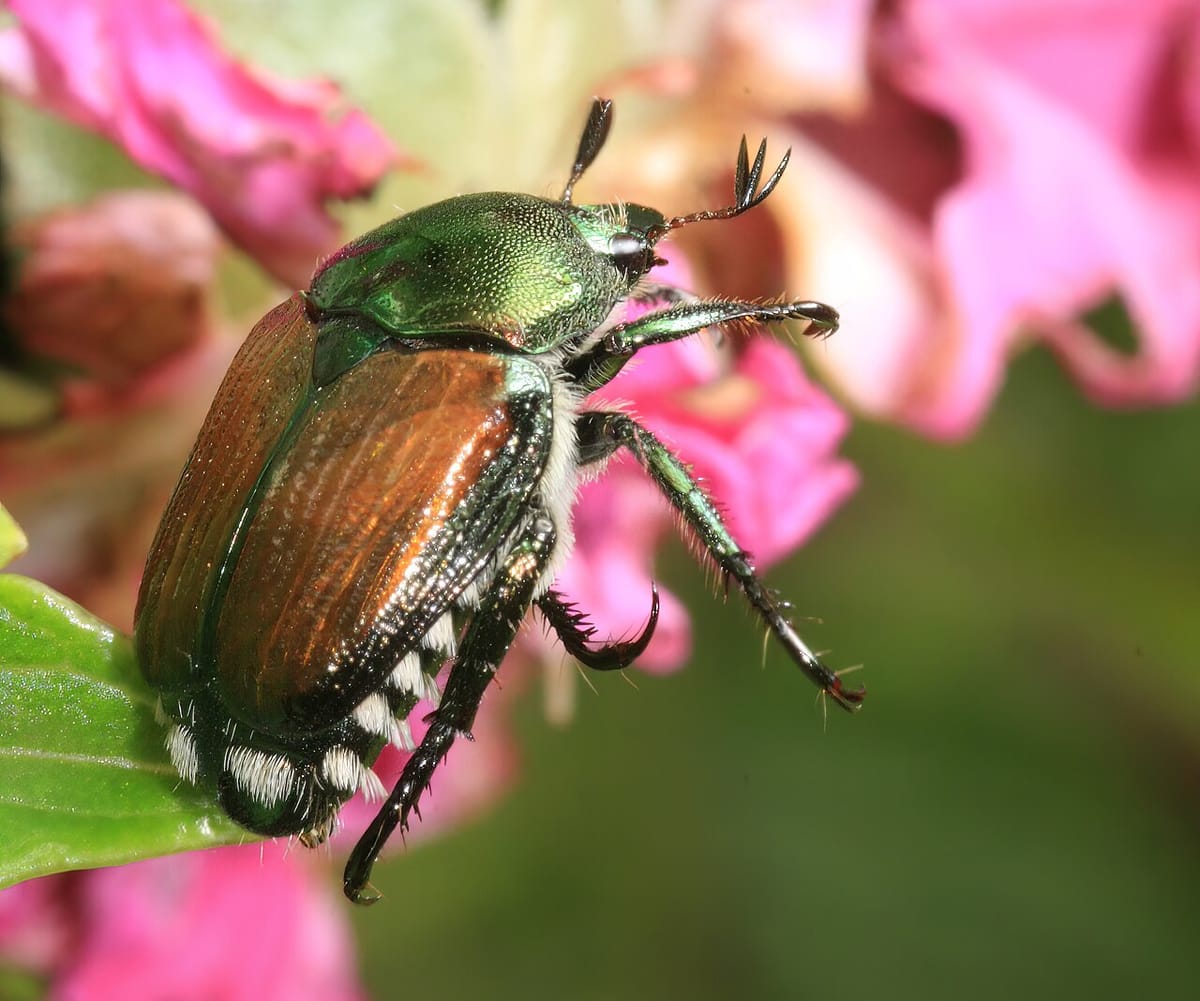
Few garden pests announce themselves as dramatically as Japanese beetles — a rose bush that looked fine on Monday can be reduced to lace-like, skeletonized leaves by Thursday, with dozens of metallic green beetles visibly feeding in broad daylight, seemingly unbothered by being watched. It’s one of the more alarming pest experiences in home gardening, and also one of the more manageable once the actual biology and effective control methods are understood — including the popular trap product that research suggests often makes things worse.
Identifying Japanese beetles and understanding their season
Adult Japanese beetles are distinctive and hard to mistake for anything else: roughly half an inch long, with metallic green bodies and coppery-bronze wing covers, typically feeding in clusters of several to dozens on the same plant rather than scattered individually. They’re most active on warm, sunny days, considerably less active in early morning cool or overcast conditions.
Japanese beetles are an invasive species in North America, established across much of the eastern and midwestern United States since the early 20th century, where they lack the natural predators that keep populations in check in their native range. Adult activity is concentrated in a 6 to 8 week window, typically late June through August depending on region and weather, after which the season’s adults die off naturally — damage that looks severe during this window often appears far less dramatic once the plant pushes new growth after the beetles are gone for the year.
Why they cause such visible damage so fast
Japanese beetles feed on the tissue between leaf veins, leaving the veins themselves intact — the resulting skeletonized, lace-like leaf pattern is their signature damage, distinct from the more general chewed holes other leaf-eating pests leave behind. They also have a documented tendency to aggregate on already-damaged plants: chewed leaves release volatile compounds that attract more beetles to the same plant, meaning a small initial feeding site can escalate into a much larger cluster within days if left unaddressed — one of the reasons early intervention matters more with this pest than with many slower-building infestations.
The trap that often makes things worse
Pheromone- and floral-scent-based Japanese beetle traps are widely sold and widely misunderstood. Research has repeatedly found that these traps attract considerably more beetles to a property than they capture, meaning a trap placed in a home garden can function as a beetle magnet for the whole neighborhood rather than a genuine control tool. If used at all, they’re better suited to monitoring beetle activity timing (placed well away from valued plants) than as a primary control strategy — and many extension services now actively recommend against using them for residential pest control specifically because of this backfire effect.
Alt: Bucket of soapy water used to hand-collect Japanese beetles from a rose bush
Caption: Unglamorous, daily, and considerably more effective than the traps sold to do this job.
Hand-picking: the most reliable home control method
Despite requiring daily repetition during peak season, hand-picking into soapy water is one of the most consistently effective control methods available to home gardeners, and it works because of a specific behavioral quirk: Japanese beetles are notably sluggish in the cool of early morning, much less likely to fly away when disturbed than during the warmer, more active parts of the day.
The technique: hold a bucket of soapy water beneath the affected plant in early morning, then knock or brush beetles directly into it — many will simply drop when disturbed rather than flying, especially before the day has warmed. The soap breaks the surface tension and prevents beetles from climbing back out or flying off once they hit the water. Repeating this daily during the peak weeks of the season measurably reduces the population feeding on a given plant, and is a worthwhile daily habit for high-value plants like roses during the beetle season specifically.
Row covers and physical exclusion
For smaller plants and vegetable crops, floating row covers installed before beetle activity ramps up physically exclude adults from reaching leaves at all — the same exclusion principle covered for other pests like cucumber beetles and squash bugs. This isn’t practical for large plants like roses or fruit trees, but works well for vulnerable smaller plantings during the peak weeks of beetle season.
Addressing the grub stage in lawns
Japanese beetle larvae — white, C-shaped grubs — live in soil, commonly in lawns, feeding on grass roots and sometimes causing irregular brown patches, particularly noticeable in late summer and fall when grub populations peak before overwintering. Two biological control options exist for lawn grubs: beneficial nematodes, applied to moist soil, which parasitize grubs directly, and milky spore, a bacterial disease specific to Japanese beetle grubs that can provide control lasting several years once established, though it takes time to build an effective population in the soil.
It’s worth setting expectations honestly here: treating grubs in your own lawn reduces the beetles that emerge from your property specifically, but adult beetles are highly mobile and can readily fly in from neighboring untreated lawns regardless of your own grub control efforts — meaning lawn grub treatment is a longer-term, area-wide strategy rather than a guaranteed fix for a given season’s adult beetle pressure on your specific plants.
Choosing resistant plants for new plantings
Several common landscape plants show consistent resistance to Japanese beetle feeding, worth prioritizing when adding new plants in a beetle-prone area: boxwood, most conifers, lilac, red maple, and many culinary herbs are reliably left alone even when beetle populations are otherwise high nearby. This doesn’t help with plants already established and favored by beetles (roses being the classic example), but it’s a genuine long-term strategy for reducing overall pressure as a landscape matures and turns over its plantings.
Protecting vegetable gardens specifically
Beans, grapes, and some fruit tree foliage are common Japanese beetle targets in the vegetable and edible-landscape portion of a yard, in addition to the ornamentals covered above. Row covers, per the same exclusion principle used against cucumber beetles and squash bugs, work well on lower-growing crops during the peak beetle weeks, though they need removing during flowering if the crop depends on pollinator visits. For beans specifically, established plants generally tolerate a fair amount of Japanese beetle leaf damage without a meaningful yield loss, since bean foliage regenerates readily — reserving intervention for heavy, sustained feeding rather than reacting to the first beetles spotted.
A note on regional variation
Japanese beetle pressure varies considerably even within the broadly affected eastern and midwestern US — some areas see a light, barely noticeable presence most years, while others deal with heavy annual populations. Checking with a local extension office for regional timing and severity trends is worth doing in the first year or two of dealing with this pest in a new garden, since it calibrates how aggressively any of the control methods above are worth pursuing for a given location.
What to skip: broad-spectrum insecticides as a first response
While insecticides labeled for Japanese beetles do exist and can reduce populations, broad-spectrum products carry the same downside covered throughout our pest guides: they kill beneficial insects — pollinators, predatory species — alongside the target pest, and given beetles’ mobility and tendency to re-arrive from neighboring properties, broad spraying often needs frequent reapplication to maintain control, compounding the ecological cost. Reserve this as a later option for severe, ongoing infestations on high-value plants, after hand-picking, exclusion, and resistant-plant strategies have been tried, following the same gentle-first escalation philosophy covered in our general pest guide.
Managing expectations through the season
Japanese beetle damage looks alarming in the moment — skeletonized leaves are visually dramatic — but established, healthy plants generally tolerate a season of beetle feeding without lasting harm, since the damage is cosmetic to leaf tissue rather than an attack on roots or the plant’s core structure. Combining daily hand-picking during the peak weeks, row covers for vulnerable smaller plants, resistant choices for new plantings, and patience through the roughly six-to-eight-week adult season is a realistic, ecologically sound approach that avoids both the trap-magnet mistake and the broader collateral damage of routine broad-spectrum spraying.
Frequently asked questions
What do Japanese beetles look like?
Adult Japanese beetles are about half an inch long with metallic green bodies and coppery-bronze wing covers, often seen feeding in clusters of several to dozens on the same plant. They're most active on warm, sunny days from roughly late June through August in much of the eastern and midwestern United States, where they're an introduced, invasive species.
Do Japanese beetle traps actually help control an infestation?
Generally not for home use — research has repeatedly shown that pheromone traps sold for residential yards often attract more beetles to the property than they actually capture, effectively making a local infestation worse rather than better. They can be useful for monitoring beetle activity timing, but are not recommended as a primary control method.
What time of day are Japanese beetles easiest to hand-pick?
Early morning, when beetles are still sluggish from the overnight cool and much less likely to fly away when disturbed. A bucket of soapy water held beneath the plant, with beetles knocked or brushed directly into it, is one of the most effective control methods available to home gardeners despite requiring daily repetition during peak season.
Which plants do Japanese beetles prefer?
Roses, grapes, linden trees, and many fruit trees are among their most preferred hosts, though they'll feed on several hundred plant species when populations are high. Beetles tend to aggregate on already-damaged plants, since damaged leaves release volatile compounds that attract more beetles — meaning an infestation can compound quickly once it starts on a given plant.
What is the grub stage of the Japanese beetle life cycle, and does it matter for lawns?
Japanese beetle larvae (grubs) live in soil, commonly in lawns, feeding on grass roots and sometimes causing irregular brown patches, especially in late summer and fall. Treating lawn grubs (with beneficial nematodes or milky spore, both slower-acting biological options) can reduce the following year's adult beetle population somewhat, though adult beetles are also mobile and can arrive from neighboring properties regardless of local grub control.
Are there plants that Japanese beetles tend to avoid?
Yes — several common landscape plants show consistent resistance, including boxwood, most conifers, lilac, red maple, and many culinary herbs. Choosing resistant plants for new plantings in a beetle-prone area reduces the ongoing pressure without needing to rely entirely on active control methods each season.
How long does Japanese beetle season last?
Adult beetle activity typically runs about 6 to 8 weeks, usually from late June into August depending on region and weather, after which adults die off naturally for the year. Damage that seems severe during this window often looks much less dramatic by the time the plant has a chance to push new growth once beetle activity ends.