USDA Hardiness Zones Explained: Find Yours and Actually Use It
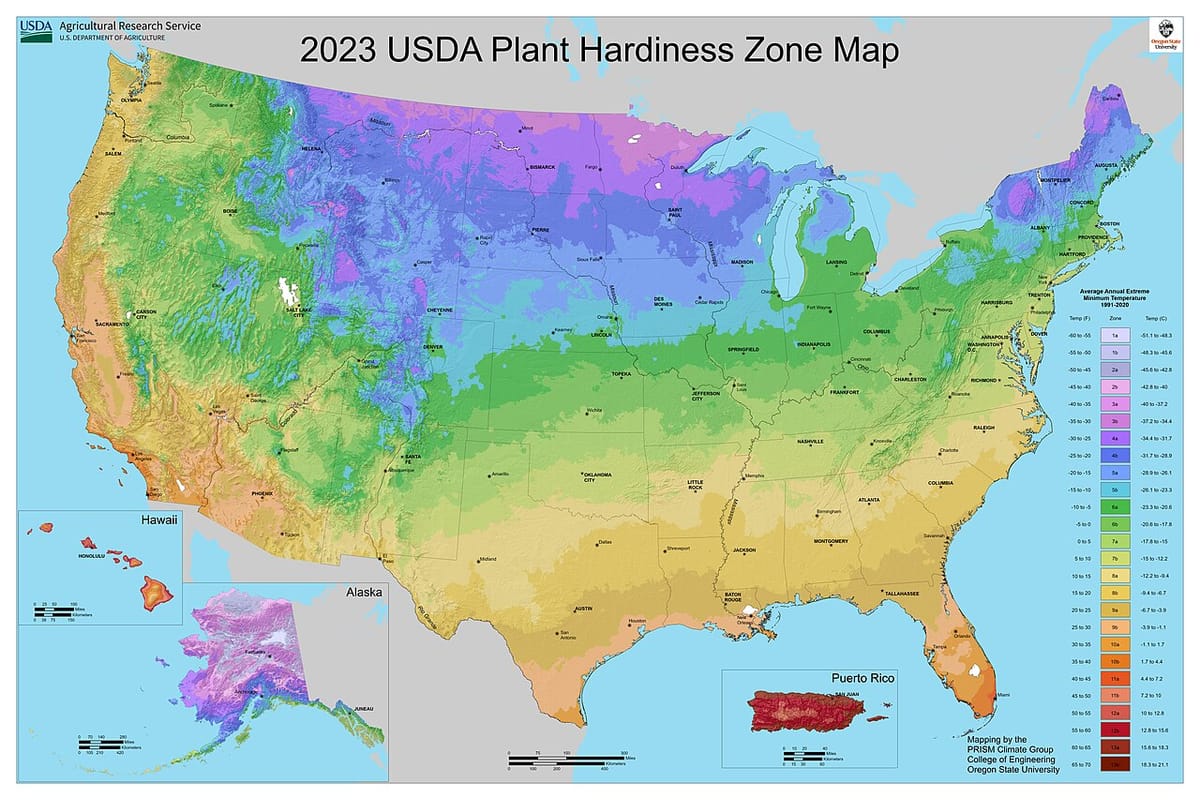
Sooner or later, every gardener meets the phrase — on a plant tag, in a catalog, from a nursery clerk: “Hardy in zones 5–9.” It sounds technical enough that beginners either ignore it entirely (and buy beautiful plants doomed to die in January) or treat it as gospel that governs everything (and skip perfectly growable plants out of caution). Both misread what the zone system is: a single, useful, deliberately narrow piece of information.
Understanding it takes about ten minutes, saves real money every planting season, and — maybe most usefully — teaches you which gardening advice on the internet applies to your yard and which was written for someone two thousand miles away.
What the zone system measures
The USDA Plant Hardiness Zone Map divides North America into numbered bands based on exactly one statistic: the average annual extreme minimum temperature — that is, take the coldest night of each winter over a 30-year run of data, and average those.
- Each full zone spans 10°F of that average minimum. Zone 5 averages a yearly low of −20 to −10°F; zone 7, 0 to 10°F; zone 9, 20 to 30°F.
- Each zone splits into a (colder half) and b (warmer half), 5°F apart. Zone 6b is meaningfully different from 6a if you’re planting borderline shrubs.
- Lower numbers are colder. Northern Minnesota gardens in zone 3; Miami in zone 11.
Finding yours takes thirty seconds: enter your ZIP code at the USDA Plant Hardiness Zone Map. Do this even if you “know” your zone — the map was substantially updated in 2023 using 1991–2020 weather data, and roughly half the country landed a half-zone warmer than on the previous 2012 map. Plenty of gardeners are quoting a zone their yard no longer has.
When a plant tag says “hardy to zone 5,” it’s making one promise: an established specimen of this plant should survive the typical worst winter night in zone 5. That’s the entire transaction.
What zones don’t tell you (a longer list than most think)
Here’s where the system gets misused. Your zone number says nothing about:
- Summer heat. Zone 8 includes both Seattle and central Texas — one has cool, cloudy summers, the other four months of 95°F. A lilac thrives in zone-8 Seattle and sulks in zone-8 Texas, at identical winter hardiness. (The American Horticultural Society publishes a separate heat-zone system, and Southern gardeners learn to read “full sun” tags with regional suspicion.)
- Frost dates. When your last spring frost and first fall frost fall — the numbers your whole planting calendar runs on — varies within a single zone by weeks.
- Rainfall and humidity. Zone 7 covers high-desert New Mexico and soggy coastal Virginia.
- Snow cover, which insulates. A zone-4 garden under reliable snow often overwinters perennials better than a zone-5 garden with bare, wind-scoured ground.
- Soil, wind, drainage — all of which decide marginal cases more often than temperature does.
The practical translation: zones are a screening tool for buying perennials, not a gardening climate profile. They answer “will this survive my winter?” and no other question.
Zones and annuals: mostly irrelevant, and that’s freeing
Most of what fills a first garden — tomatoes, beans, zinnias, basil, lettuce — are annuals: they sprout, produce, and die inside one growing season. Winter never enters their story, so hardiness zones barely apply. A tomato grows identically in zone 4 and zone 9; the zone-4 gardener just has a shorter window.
For annuals, the numbers that matter are your frost dates and the season length between them. Those come from your local extension service, and they drive when to sow, when to transplant, and whether that gorgeous 110-day melon can finish where you live. Our guides to starting a garden and the spring checklist run on frost dates, not zones, for exactly this reason.
Zones take over the moment you buy anything meant to come back: perennial flowers, herbs like rosemary (hardy only to about zone 7–8, which is why northern gardeners pot it and bring it in), berry bushes, fruit trees, ornamental shrubs. There, the zone check is non-negotiable — it’s the difference between a plant and an annual rental priced like a plant.
Alt: Annotated annual and perennial plant tags showing frost dates versus hardiness zone information
Caption: Two tags, two systems: annuals run on frost dates, perennials on zones.
Microclimates: your yard is not one zone
The zone map’s resolution is measured in miles; your garden’s weather varies by the foot. Every yard contains microclimates — pockets that run effectively warmer or colder than the official designation:
Warmer pockets:
- Against a south-facing wall, especially brick or stone, which soaks up daytime heat and releases it overnight — the classic spot worth up to half a zone.
- Under eaves and mature evergreens, sheltered from radiational frost.
- Urban cores generally run warmer than surrounding countryside (pavement is a heat battery).
- Beside paving, boulders, and water features.
Colder pockets:
- Low spots. Cold air flows downhill like water and pools in hollows and at the base of slopes — these “frost pockets” frost first in fall and last in spring.
- Wind-exposed corners, where winter wind strips away both warmth and moisture (windburn kills as surely as cold).
- North-facing slopes and walls, sunless all winter.
Learning your yard’s map is a one-winter observation project: note where frost appears first and melts last, where snow lingers, which corner the wind owns. Then use it — the borderline fig goes against the south wall, the reliably hardy shrubs take the frost pocket, and suddenly you’re growing things your zone number says you can’t.
That practice has a name, zone-pushing, and the recipe is stacked advantages: warmest microclimate + sharp drainage (winter wet kills marginal plants faster than cold — a lesson our rosemary-growing readers know well) + deep autumn mulch + wind shelter. Push with plants you can afford to lose; the backbone of the garden should be rated for your zone with room to spare.
Reading zone ranges like a buyer
Tags and catalogs give a range: “Zones 5–9.” The low number is winter survival; the high number matters too — it’s often about chill and heat: many plants (lilacs, peonies, most apples, tulips treated as perennials) require winter cold to flower properly, and fail southward not from freezing but from never getting their winter sleep. A zone 5–8 rating in zone 10 isn’t a dare; it’s a no.
A few buying habits that pay:
- Shop your half-zone, not your zone. In 6a, a “hardy to zone 6” plant is a coin flip in a bad winter; “hardy to zone 5” is a safe purchase.
- Prefer regional sources. A ‘zone 6’ plant propagated and field-grown in your region carries better-adapted genetics and honest ratings; the same label from a distant mega-nursery is a rougher estimate. Local extension plant lists and the Missouri Botanical Garden Plant Finder give more nuanced hardiness notes than tags do.
- Plant perennials early enough to establish — spring or early fall. A shrub planted in late November enters winter with no root system and its zone rating voided.
Why zone-hardy plants still die (the fine print)
The rating assumes an established, healthy plant in reasonable conditions. The usual real-world killers of “hardy” plants:
- Wet feet. Waterlogged winter soil rots roots at temperatures the plant could otherwise shrug off. Drainage is winter armor.
- No establishment time. First-winter plants are the most vulnerable; mulch them well and don’t judge the rating by them.
- Desiccating wind, especially for evergreens, which lose water all winter through their leaves and can’t replace it from frozen ground.
- The average is an average. Zones describe typical extreme lows; once a decade, winter ignores the paperwork. Losses in a record year aren’t your fault or the map’s.
- Pot living. Roots in containers experience air temperature, not insulated ground temperature — a potted perennial effectively gardens two zones colder. Overwinter pots against the house, buried, or mulched-in.
The two-number habit
Here’s the whole system as a habit: know two numbers — your zone (updated, half-zone precision) and your last frost date — and ask of every plant which number governs it. Coming back next year? Zone. One season and done? Frost date. That single sorting question, asked in the nursery aisle, prevents most climate-related disappointment a gardener can buy.
Then go find your south-facing wall, and start plotting what the map says you can’t grow.
Frequently asked questions
What does my USDA zone actually tell me?
One thing: your area's average annual extreme minimum winter temperature, in 10°F bands (with 5°F half-zones labeled 'a' and 'b'). It predicts whether a perennial, shrub, or tree is likely to survive your typical winter. It says nothing about summer heat, rainfall, humidity, soil, or frost dates.
How do I find my hardiness zone?
Enter your ZIP code at the USDA Plant Hardiness Zone Map website (planthardiness.ars.usda.gov). The map was updated in 2023 using 1991–2020 weather data, and about half the country shifted a half-zone warmer compared to the 2012 version — so if you learned your zone years ago, it's worth rechecking.
Do hardiness zones matter for annual flowers and vegetables?
Barely. Annuals — which includes most vegetables — complete their life in one season and never face your winter, so zone-based survival doesn't apply. For annuals, the numbers that matter are your last and first frost dates and the length of season between them. Zones matter enormously for anything you expect to come back: perennials, shrubs, trees, and fruit.
What's the difference between hardiness zone and frost dates?
Zone describes how cold your worst winter night typically gets; frost dates describe when the last spring frost and first fall frost usually occur. Two towns can share a zone but differ by weeks in frost dates. Perennial shopping uses the zone; the planting calendar runs on frost dates.
What is a microclimate?
A small area whose conditions differ from the surrounding zone — a south-facing brick wall that stays half a zone warmer, a frost pocket in a low hollow, a windbreak's sheltered lee. Most yards contain several. Gardeners exploit them to grow borderline plants: the zone map is the rule, and your warm wall is the loophole.
Can I grow a plant rated one zone warmer than mine?
Sometimes — this is called zone-pushing, and it works with stacked advantages: a warm microclimate, excellent drainage (winter-wet soil kills borderline plants faster than cold), deep mulch, and a sheltered site. Treat it as a calculated bet with plants you can afford to lose, not a plan for the backbone of your garden.
Why did my zone-hardy plant still die over winter?
Zone ratings assume an established, healthy plant in decent conditions. The usual culprits: it was planted too late to establish roots, the soil stayed waterlogged (cold wet roots rot), it dried out in a windy freeze, an extreme year beat the average, or the plant was root-bound or stressed going in. Hardiness is necessary, not sufficient.