15 Best Low-Light Houseplants That Actually Thrive
Most houseplant disappointment starts with a mismatch: a sun-loving plant sentenced to a dim corner, or — just as often — a “low light” label that oversold what the plant can endure. The truth is that a handful of species do tolerate the light levels found in average apartments, north-facing rooms, and offices. They evolved on shaded forest floors, and your living room, from their perspective, is just a very tidy forest.
This guide covers fifteen of them, honestly: what each plant needs, how it behaves in low light, and the mistake most likely to kill it. First, though, it’s worth thirty seconds to define terms, because “low light” is the most abused phrase in the houseplant world.
What “low light” really means
Plant light levels, roughly, from brightest to dimmest:
- Direct sun: sunbeams physically touch the leaves for hours. South and west windowsills.
- Bright indirect: near a sunny window but out of the beam, or behind a sheer curtain. What most popular houseplants want.
- Medium light: a few feet back from an east window; a bright room’s interior.
- Low light: you can read a book comfortably by daylight, but no direct sun ever lands there. North windows, interior walls of bright rooms, spots several feet from any window.
- No light: windowless rooms, dark corners. Nothing on this list survives here long-term — see the FAQ about grow lights.
A useful test: at midday, hold your hand a foot above where the plant will sit. A crisp shadow means medium-to-bright light. A soft, fuzzy shadow means low light — workable for everything below. No shadow at all means you’re shopping for a lamp, not a plant.
One more expectation to set: in low light, every plant grows slowly. That’s not failure; it’s economics. Less light, less energy, fewer new leaves — and much less water needed, which is where most low-light casualties come from.
The fifteen plants
1. Pothos (Epipremnum aureum)
The benchmark. Pothos tolerates low light, irregular watering, dry air, and neglect bordering on rudeness, trailing happily off shelves the whole time. Golden and jade forms hold up best in dim spots; highly variegated types (Marble Queen, N’Joy) lose their patterning without more light. Water when the top two inches of soil are dry. Toxic to pets if chewed.
Kills it: soggy soil. Pothos forgives drought and punishes swamps.
2. Snake plant (Dracaena trifasciata)
Architectural, nearly indestructible, and content in light ranging from dim corner to full sun. In low light it grows slowly and needs watering as little as once a month. Its thick upright leaves store water like a succulent’s — treat it like one. It’s forgiving enough that we gave it a full care guide for anyone who wants to master rather than merely keep it. Toxic to pets.
Kills it: winter overwatering. Cold plus wet equals rot.
3. ZZ plant (Zamioculcas zamiifolia)
Glossy, sculptural, and equipped with potato-like rhizomes that store months of water. The ZZ handles the dimmest survivable spots of any plant here and still looks like it was polished this morning. New stems emerge light green and darken — that’s normal, not a problem. Toxic if chewed.
Kills it: kindness. Water roughly monthly; less in winter.
4. Cast iron plant (Aspidistra elatior)
Named for its constitution. Deep green paddle leaves, unbothered by low light, temperature swings, and dust. The Victorians kept it alive in gas-lit parlors, which were plant purgatory. Slow-growing to the point of stillness — buy the size you want. Pet-safe.
Kills it: almost nothing except standing water and direct scorching sun.
5. Chinese evergreen (Aglaonema)
One of the few colorful low-light options: silver, cream, and (in newer cultivars) pink-splashed foliage. Older green-and-silver varieties handle the least light; the pinker the leaf, the more light it needs to keep its color. Likes warmth — keep it away from cold drafts. Toxic to pets.
Kills it: cold. Below about 60°F (15°C) it sulks and spots.
6. Peace lily (Spathiphyllum)
Lush tropical foliage plus, if light permits, white hooded blooms. In true low light expect fewer flowers and enjoy it as a foliage plant. Famous for its drama: it wilts theatrically when thirsty and recovers completely within hours of watering — the closest a plant comes to communicating. Toxic to pets.
Kills it: ignoring the wilt one time too many, and hard water (it’s sensitive to fluoride; browning leaf tips often trace to tap water).
7. Heartleaf philodendron (Philodendron hederaceum)
Pothos’s more refined cousin: smaller heart-shaped leaves, same trailing habit, same tolerance for dim corners and forgetful owners. Pinch the vine tips occasionally and it branches into a fuller plant instead of one long string. Toxic to pets.
Kills it: the same swampy soil that kills pothos.
8. Parlor palm (Chamaedorea elegans)
A genuine palm that accepts low light — rare among palms, most of which secretly want a greenhouse. Slow-growing, feathery, and pet-safe, it brings actual tree energy to dim rooms. Likes its soil lightly moist and its air not bone-dry.
Kills it: spider mites in dry winter air. Shower the foliage every few weeks as prevention.
9. Spider plant (Chlorophytum comosum)
The hanging-basket classic, pet-safe and cheerfully productive even in modest light — though in true low light it will pause the baby-making. Browning tips are its signature complaint, usually about fluoridated tap water or erratic watering, and are cosmetic.
Kills it: honestly, very little. One of the safest first plants there is.
10. Dieffenbachia (dumb cane)
Big, painterly cream-and-green leaves that read “expensive tropical” on a hardware-store budget. Tolerates medium-low light well; in very dim spots the leaves shrink. The sap is irritating — its common name refers to the mouth-numbing effect of chewing it — so site it away from pets and toddlers.
Kills it: cold drafts and waterlogging.
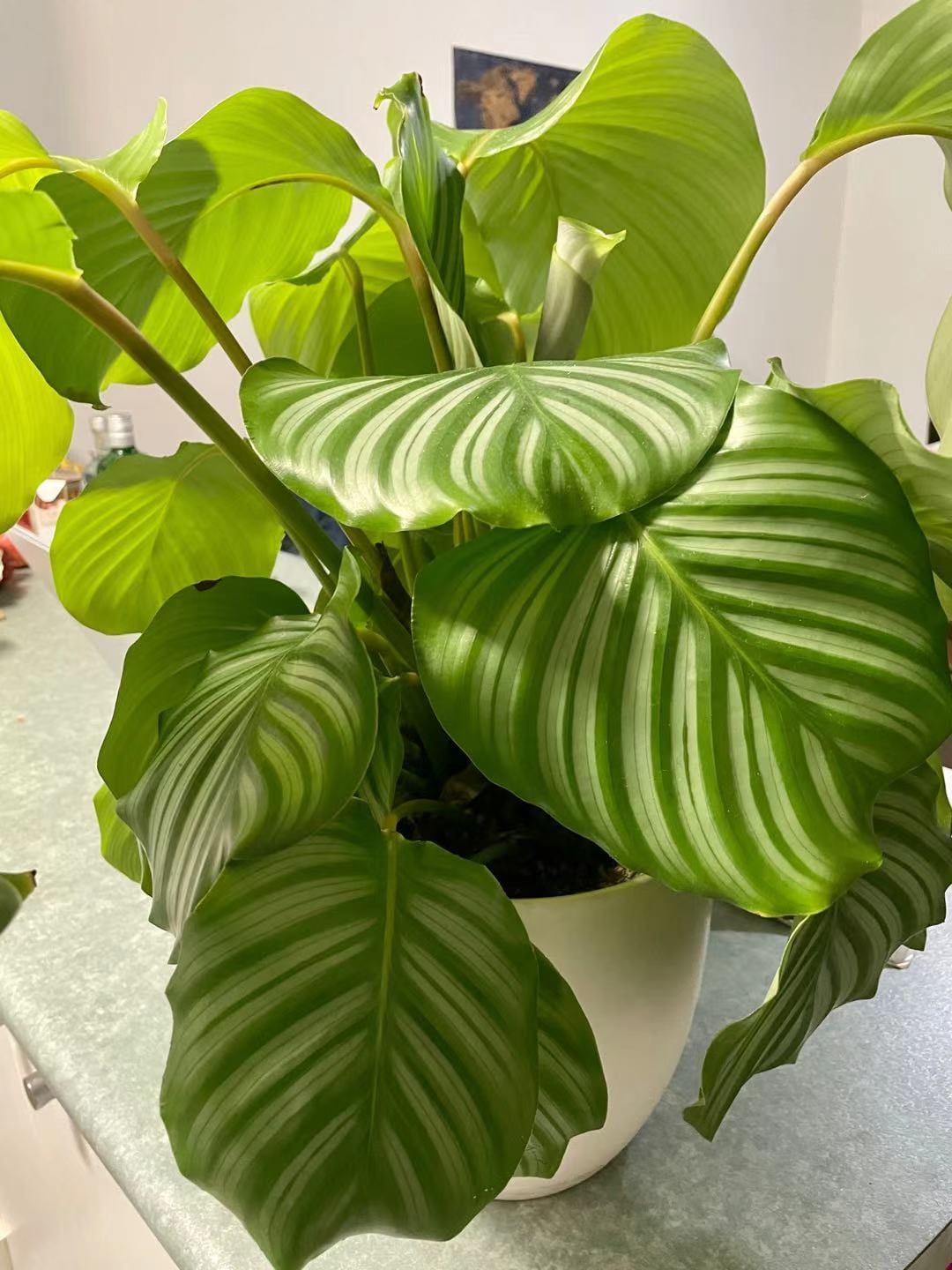
11. Calathea / prayer plant group (Goephertia, Maranta)
The most beautiful foliage on this list — striped, spotted, purple-backed — and the fussiest entry, included because it truly prefers no direct sun. Give it low-to-medium light, consistently lightly moist soil, and ideally filtered or rain water; browning edges are its review of your tap water. It folds its leaves upward at night, audibly rustling. Pet-safe, which excuses a lot.
Kills it: dry air and neglect. This is a plant for people who enjoy tending.
12. Lucky bamboo (Dracaena sanderiana)
Not bamboo — a dracaena that famously grows in plain water. Content in quite low light; keep the water topped up and swap it every couple of weeks. In soil it’s even sturdier. A desk plant that survives offices, which is the harshest habitat science knows. Toxic to pets.
Kills it: chlorinated water in small vessels — let tap water sit overnight before topping up.
13. Peperomia (baby rubber plant and kin)
Compact, thick-leaved, pet-safe, and happy on a dim shelf. Its semi-succulent leaves mean it would rather be forgotten than fussed over. Dozens of leaf forms — rippled, striped, coin-round — all with the same easy care.
Kills it: overwatering, the usual suspect. Let the top half of the pot dry out.
14. Dracaena (corn plant, dragon tree)
Tall, treelike structure for corners that need height. Corn plants (D. fragrans) with solid green leaves handle low light best; the spiky marginata types want a bit more. Slow, steady, undemanding. Toxic to pets — and notably sensitive to fluoride, so brown tips often mean “filtered water, please.”
Kills it: overwatering a big pot that dries slowly.
15. English ivy (Hedera helix)
A cool-room specialist: it prefers the chilly, bright-ish conditions of entryways and drafty older homes that tropical plants hate. Trails or climbs politely indoors. Toxic to pets, and in many regions invasive outdoors — keep it a houseplant.
Kills it: hot dry rooms, which invite spider mites.
Alt: Fifteen low-light houseplants arranged on shelves and labeled by name and difficulty
Caption: The full roster. Top shelf: nearly unkillable. Bottom shelf: worth a little fuss.
Care rules that apply to every plant above
Low light changes the care math in predictable ways:
- Water less than you think. Slow growth means slow drinking. The finger test — water only when the top inch or two is dry — replaces every schedule. For most of these plants in winter, that can mean every three to four weeks. Our guide to watering houseplants properly goes deeper.
- Drainage is non-negotiable. Every pot needs a drainage hole. A beautiful holeless cachepot is fine — as an outer sleeve with a plain nursery pot inside that you can lift out to water.
- Feed sparingly. Two or three half-strength feedings across spring and summer. None in winter.
- Dust the leaves. In low light, a layer of dust meaningfully cuts the little light the plant gets. A monthly wipe with a damp cloth is care, not housekeeping.
- Rotate a quarter-turn at each watering so growth stays even instead of lunging windowward.
- Read legginess as a message. Stretched stems and shrinking new leaves mean “more light, please.” Even moving a plant three feet closer to a window can double its light.
Building a corner that works
A last piece of honest advice: the lushest “low light corners” you see online usually cheat — either the plants rotate to brighter rooms on a schedule, or there’s a small grow light involved. Both cheats are available to you. A clip-on full-spectrum LED on a $10 timer turns any bookshelf into medium light for pennies a month, and none of your guests will spot it.
Start with three from the top of the list — a pothos to trail, a snake plant for height, a ZZ for gloss. If all three are alive and pushing new leaves in six months (they will be), add the calathea you were eyeing. By then, checking soil with a finger will be habit, and habit is nine-tenths of a green thumb.
Frequently asked questions
What does 'low light' actually mean for houseplants?
Low light means bright enough to read comfortably without a lamp during the day, but with no direct sun — think a few feet from a north window, or across the room from an east one. It does not mean a windowless bathroom or a dark hallway. No plant grows in genuine darkness; 'low light tolerant' means survives and grows slowly, not thrives in a cave.
Can any plant live in a room with no windows?
Not on ambient ceiling light alone for the long term. In a windowless room your options are rotating plants out to brighter spots every few weeks, or a small LED grow light on a timer (8–12 hours a day), which changes the equation completely and costs little to run.
Which low-light houseplants are safe for cats and dogs?
From this list: calathea, most ferns, cast iron plant, parlor palm, peperomia, and spider plant are considered non-toxic to cats and dogs. Pothos, philodendron, ZZ plant, snake plant, aglaonema, and dieffenbachia are toxic if chewed — check the ASPCA database before buying if you have a curious pet.
How often should I water plants in low light?
Much less often than the same plant in bright light — low light means slow growth and slow water use. Ignore schedules entirely: check the soil with a finger every week or so and water only when the top inch or two is dry. Overwatering is the number-one killer of low-light plants.
Why is my low-light plant getting leggy?
Long bare stems, small new leaves, and growth leaning hard toward the window all say the plant wants more light than it's getting. It's not dying — it's economizing. Move it a few feet closer to a window or add a grow light; you can trim leggy growth once new compact growth appears.
Do low-light plants need fertilizer?
Barely. Slow growth means low nutrient demand. A half-strength dose of balanced houseplant fertilizer two or three times across spring and summer is plenty; skip feeding entirely in fall and winter. Overfeeding a slow-growing plant burns roots and browns leaf tips.