Tomato Hornworm: Identification, Control, and Why Some Should Be Left Alone
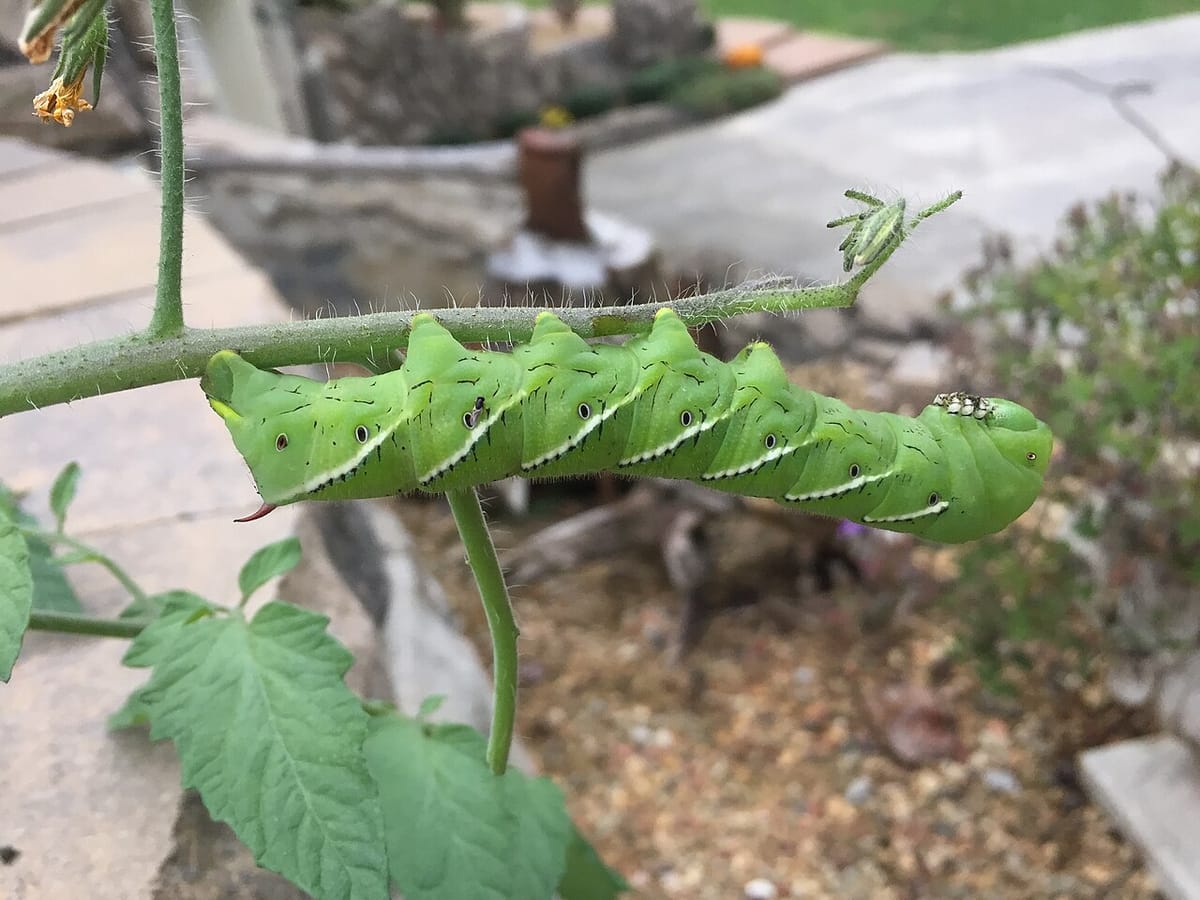
Few garden pests deliver as much shock value as the tomato hornworm — a caterpillar that can grow to four inches long, feeding in plain sight on a tomato plant’s upper leaves, somehow noticed only after it’s already stripped a startling amount of foliage. Its size makes it alarming; its camouflage makes it sneaky; and one specific detail about how it’s sometimes already being handled by nature makes it one of the more interesting pest identification lessons a tomato grower can learn.
Identification: bigger than it seems possible, and remarkably well hidden
Tomato hornworms are the larval stage of a large moth (the five-spotted hawk moth), and the caterpillar itself is large — up to 4 inches long at full maturity, thick-bodied, and a bright green that should, in theory, stand out against tomato foliage. In practice, the caterpillar’s coloring and its habit of resting along stems and leaf undersides make it surprisingly easy to miss even at that size. Look for:
- Bright green body with white diagonal or V-shaped stripes along each side — mature caterpillars typically show around eight of these markings per side.
- A dark, horn-like projection on the rear end, which despite its intimidating appearance is completely harmless — it doesn’t sting, bite, or cause any injury, and hornworms are entirely safe to handle by hand.
- Dark green to black droppings, roughly pellet-shaped, on leaves beneath where a hornworm is actively feeding — often the first sign of an infestation, noticed before the caterpillar itself is spotted.
- Chewed leaves and stripped stems, typically starting on upper portions of the plant, sometimes progressing to include damage on developing fruit in heavier infestations.
Tobacco hornworms, a very similar-looking relative species, are often confused with tomato hornworms and feed on the same plants using the same general habits — the practical distinction between the two (subtle differences in the diagonal stripe pattern and horn color) matters far less than correctly identifying the general hornworm profile above, since control methods are identical for both species.
The parasitic wasp cocoons: the detail worth knowing before you act
Here’s the identification detail that changes how to respond: if a hornworm is found covered in small, white, rice-grain-shaped cocoons protruding from its body, do not remove or kill that caterpillar. Those cocoons belong to a parasitic braconid wasp that has laid eggs inside the hornworm’s body — the wasp larvae have been consuming the caterpillar from within, and what’s visible on its back are their cocoons as they complete development.
The parasitized hornworm is already effectively dying and will stop feeding on the plant soon regardless of any intervention. More importantly, the adult wasps that emerge from those cocoons will go on to parasitize many more hornworms throughout the garden over the rest of the season, functioning as an effective natural biological control. Removing or killing a parasitized hornworm eliminates that ongoing pest-control benefit for the sake of stopping damage from a caterpillar that was already on its way out — a rare case in gardening where the correct response to visible pest damage is to leave the pest alone.
Alt: Tomato hornworm covered in parasitic braconid wasp cocoons
Caption: The one hornworm in the garden you should walk right past — the wasps have already done the work for you.
Hand-picking: the most effective home garden method
For hornworms without visible parasitic cocoons, hand-picking is generally the most effective control available to home gardeners, following the same gentle-first pest management approach that applies across most garden pests:
- Check plants in early morning or evening, when hornworms are often more active and visible, and look specifically for chewed leaves and dark droppings as clues pointing to a feeding location, then trace upward or along the stem to spot the caterpillar itself.
- A UV blacklight flashlight used after dark reveals hornworms with striking clarity — their skin fluoresces a bright yellow-green under ultraviolet light, making them glow visibly against the foliage in a way daylight searching simply can’t match. This is an effective and somewhat fun technique for anyone struggling to spot hornworms by daylight alone.
- Remove spotted caterpillars by hand — they’re harmless to touch despite the intimidating horn — into a bucket of soapy water, or simply relocate them away from the garden if preferred.
Bt spray: effective mainly on younger larvae
Bacillus thuringiensis (Bt), a naturally occurring bacterium sold as an organic-approved spray, is effective against hornworms when ingested, but works considerably better on smaller, younger larvae — generally under about half an inch long. By the time a hornworm has grown to its more commonly noticed larger size, Bt is less reliably effective, and hand-picking becomes the more practical control at that stage. This timing detail is worth knowing if considering Bt as part of a broader pest management plan — earlier intervention, before hornworms reach their alarming full size, gets more value from the spray.
Prevention for next season
Tilling garden soil in both fall and spring destroys a significant portion of overwintering hornworm pupae living in the soil, meaningfully reducing the population of adult moths that emerge to lay eggs the following season — one of the more effective prevention strategies available, and a good complement to the fall garden cleanup routine already recommended for other reasons.
Companion planting with dill, basil, or marigolds nearby is commonly suggested as a deterrent, though the research support for this specific pest-repelling effect is considerably thinner than for tilling and hand-picking — the more reliable benefit of these companion plants, per our companion planting guide, is attracting the same beneficial parasitic wasps responsible for the cocoon-covered hornworms described above, making a garden with flowering dill or basil nearby more likely to already have wasp allies working on the problem.
Why noticing them early matters more than usual
Hornworms are unusual among garden pests in how much damage can accumulate before they’re spotted, given their camouflage against tomato foliage — the same regular garden walk-through habit that catches most pests early is especially valuable here, since a hornworm left undetected for even a week or two, given its substantial appetite and size, can do considerably more damage than a comparably sized population of most other tomato pests. Checking specifically for droppings on lower leaves — a distinctive, easy-to-spot clue even when the caterpillar itself is well hidden — is the most useful early-detection habit for this particular pest.
Peppers, eggplant, and potatoes — all close relatives of tomato in the same nightshade family — can also host hornworms, so a thorough check during pest patrols shouldn’t stop at the tomato bed alone if any of these related crops are growing nearby.
The balance worth striking
Tomato hornworms are alarming in appearance and capable of real damage, but they’re also one of the clearest examples in home gardening of a pest with a built-in natural check already working in the background. Learning to tell a healthy, actively feeding hornworm (remove it) from a parasitized one already covered in wasp cocoons (leave it) turns a purely reactive pest problem into a small piece of applied garden ecology — and it’s a distinction worth the ten extra seconds of close inspection every time a hornworm turns up, long after the initial shock of finding a four-inch caterpillar has worn off.
Frequently asked questions
How do I identify a tomato hornworm?
Tomato hornworms are large, fat, bright green caterpillars — up to 4 inches long at maturity — with white V-shaped or diagonal stripes along their sides and a dark, harmless horn-like projection on their rear end. Despite their size, they blend in remarkably well with tomato foliage and are often first noticed by the dark green or black droppings they leave on leaves below where they're feeding.
Are tomato hornworms dangerous to touch?
No — the rear horn looks intimidating but is completely harmless and doesn't sting or bite. Hornworms are safe to pick up by hand for removal, though some people prefer gloves simply out of squeamishness rather than any actual risk.
What should I do if I see white cocoons on a hornworm's back?
Leave that specific caterpillar alone — those rice-grain-shaped white cocoons belong to a parasitic braconid wasp that has laid eggs inside the hornworm, and the wasp larvae are consuming it from within. The caterpillar is already dying and will stop feeding soon, and the wasps that emerge will go on to parasitize many more hornworms in your garden, making this a natural control ally worth preserving rather than removing.
What's the best way to find and remove tomato hornworms?
Hand-picking is generally the most effective home garden method — checking plants in the morning or evening, looking for chewed leaves and dark droppings as clues to where a hornworm is feeding, and removing spotted caterpillars by hand into a bucket of soapy water. A UV blacklight flashlight used after dark makes hornworms glow visibly against the foliage, making them far easier to spot than in daylight.
Does Bt spray work on tomato hornworms?
Yes, particularly on smaller, younger larvae — Bacillus thuringiensis (Bt) is a naturally occurring bacterium that's effective against caterpillars when ingested, but works best on hornworms under about half an inch long. Larger, more mature hornworms are less affected by Bt and are generally better addressed through hand-picking at that stage.
How do I prevent tomato hornworms next season?
Tilling garden soil in fall and again in spring destroys a significant portion of overwintering hornworm pupae in the soil, reducing the population that emerges as adult moths the following season. Companion planting with dill, basil, or marigolds is commonly suggested as a deterrent, though the research support for this specific effect is more limited than for the tilling and hand-picking methods.
Why didn't I notice the hornworm until my tomato plant was already badly damaged?
Hornworms are exceptionally well camouflaged against tomato foliage, and their feeding pattern — starting on upper leaves and working through significant plant material before the caterpillar itself becomes large and obvious — means real damage can accumulate before the pest is spotted. Regular close inspection, especially checking for droppings on lower leaves, catches infestations earlier than casual observation alone.