Vertical Gardening Ideas: Growing Up When You Can't Grow Out
Every garden has a ground footprint that’s essentially fixed the day the beds are laid out — but almost every garden also has vertical surfaces that go completely unused: a bare fence line, a blank wall, an empty stretch of railing. Vertical gardening is simply the practice of putting those surfaces to work, and it’s arguably the single highest-leverage move available to anyone gardening in a limited space, since it adds real growing capacity without requiring a single additional square foot of ground.
Why vertical growing multiplies capacity so effectively
A ground-level bed can only hold one layer of plants at a given footprint. A fence line or wall, by contrast, can simultaneously support a trellised vine climbing upward, a row of wall-mounted planters at mid-height, and hanging baskets above — three distinct growing zones stacked on the same linear stretch that a single ground bed would use for just one. This stacking effect is what makes vertical techniques so disproportionately valuable in small gardens and balconies specifically, though the benefits extend to gardens of any size.
Trellising: the foundation of vertical vegetable growing
Naturally vining crops adapt to trellising most readily and reward it the most. Cucumbers, pole beans, and peas all climb eagerly given something to grip, and training them vertically — rather than letting them sprawl across ground-level space — delivers straighter, cleaner fruit held up off the soil, better airflow around the foliage (reducing the fungal disease pressure covered in our powdery mildew guide), and dramatically easier harvesting, since fruit hangs at eye level rather than hidden under a tangle of ground foliage. Our cucumber growing guide covers trellising technique for that crop specifically, and the same principles apply across the vining vegetable family.
Squash and melon vines can also be trained vertically, though their heavier fruit typically needs additional support — a simple sling made from an old stocking, mesh bag, or fabric strip, tied to the trellis to bear the fruit’s weight as it develops, prevents the vine from snapping under a maturing melon or winter squash.
Building a trellis doesn’t require specialty products — sturdy netting stretched between two posts, a cattle panel bent into an arch, or basic wooden lattice all function as effective, inexpensive vertical supports, and cucumber or bean tendrils grip readily once trained to start climbing any of these options.
Structure placement matters as much as the structure itself. A trellis running north-south, oriented so climbing plants don’t cast their own tall shadow across neighboring beds all afternoon, avoids accidentally shading out shorter, sun-hungry crops planted nearby — a detail easy to overlook when a trellis goes up mid-season in response to a vine that’s already outgrown its space, rather than being planned into the layout from the start.
Alt: Cattle panel trellis arch with climbing cucumber and bean vines
Caption: A bent piece of livestock fencing, repurposed into the garden's most productive square footage.
Wall-mounted and pocket planters
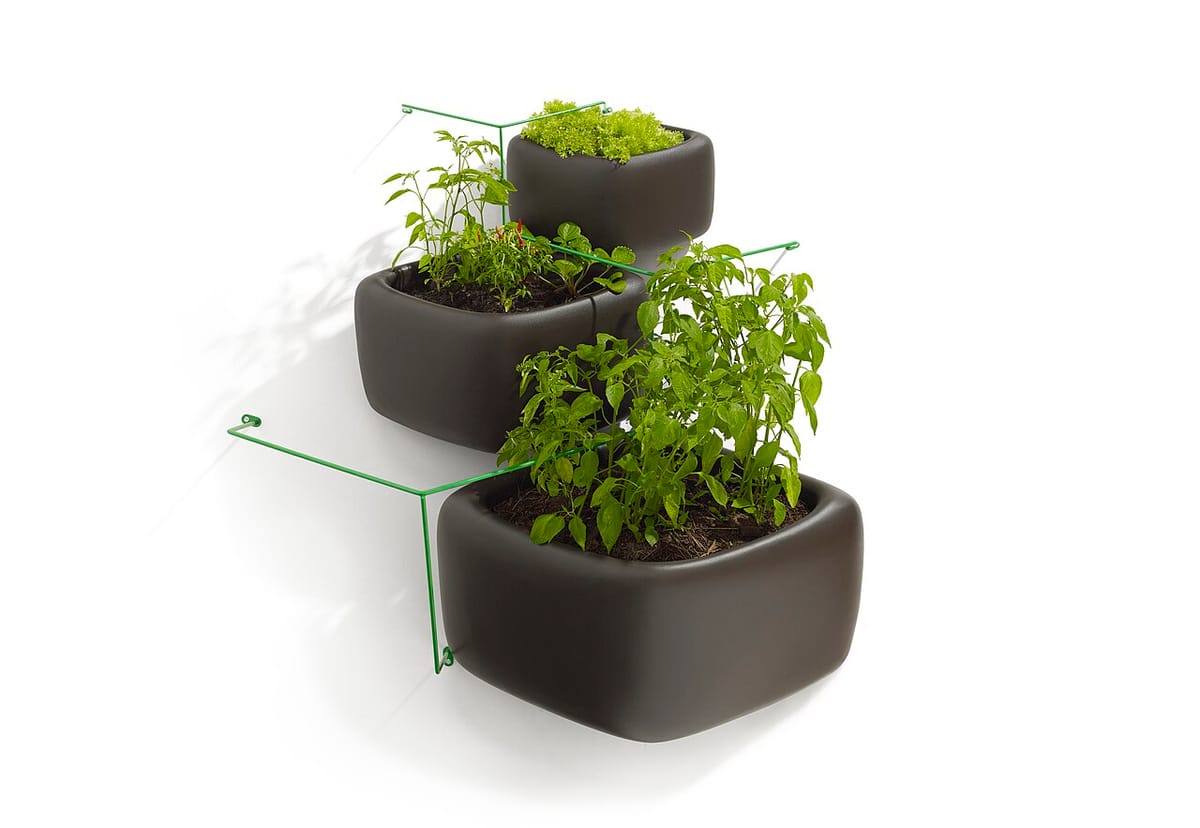
For plants that don’t naturally climb, wall-mounted planter systems — individual pockets, modular planter grids, or simple mounted boxes — provide their own soil and root zone directly on a vertical surface. This format works well for strawberries (covered in detail in our dedicated strawberry guide, which specifically discusses gutter and wall-mounted systems), compact herbs, and shallow-rooted greens, none of which need the deep soil volume a full ground bed provides.
The tradeoff with this format is faster drying — smaller soil volumes exposed on more sides to air and sun dry out considerably quicker than ground-level beds, meaning wall-mounted systems generally need more frequent watering checks, or benefit from a simple drip irrigation line run along the system to reduce the manual watering burden.
Hanging baskets and tiered stands
Hanging baskets use overhead space that’s otherwise completely unused in most gardens and patios — trailing tomatoes, strawberries, and flowering plants like petunias and lobelia all perform well suspended this way, adding a growing layer above whatever’s happening at ground or mid-height.
Tiered plant stands stack multiple pots vertically within a single small footprint, particularly useful for a dense herb collection or succession-sown salad greens spread across several levels — a practical option for a patio or balcony corner that can’t spare floor space for multiple separate pots.
Check the weight rating of any hanging or wall-mounted hardware before loading it up, especially on a balcony or apartment structure — a fully watered hanging basket is considerably heavier than its dry weight suggests, and the same structural weight considerations that apply to floor-level balcony containers apply just as much to anything suspended overhead.
Flowering vines and vertical color
Vertical gardening isn’t only about food production — several flowering vines are natural climbers well suited to the same trellising techniques used for vegetables: sweet peas, morning glory, and clematis all climb readily and provide vertical color that a ground-level flower bed alone can’t offer, adding a dimension of height and visual interest to an otherwise flat garden layout, per the layout principles that emphasize sight lines and vertical structure in overall garden design.
Structural supports: what to build versus buy
For temporary or budget-conscious setups, simple materials work well: bamboo stakes tied into a teepee shape, netting stapled to a wooden frame, or a section of chain-link fencing repurposed as a trellis. For a more permanent installation, purpose-built trellis panels, obelisks, and modular wall-planter systems are widely available and offer more durability across multiple seasons, at a higher upfront cost than the improvised alternatives.
Whatever the structure, install it before or at planting time rather than trying to retrofit support onto an already-sprawling plant — the same principle covered for tomato cages applies broadly across vertical gardening: support installed early guides growth in the right direction from the start, while support added later often damages roots or requires awkwardly redirecting growth that’s already established in the wrong direction.
Watering considerations across vertical systems
As a general rule, the more elevated and exposed a vertical growing system is, the faster it dries out — hanging baskets and wall planters typically need more frequent attention than ground-trellised vines, whose roots still draw from a full-depth bed or large container. Building a regular check-in habit for vertical plantings specifically, rather than assuming they’ll keep pace with a garden’s general watering schedule, prevents the drought stress that vertical systems are particularly prone to.
A simple drip line or soaker hose run along a vertical trellis or a series of wall planters, connected to a basic timer, largely automates this extra watering demand — a worthwhile small investment for anyone relying heavily on vertical systems, since it removes the daily manual check that these faster-drying setups would otherwise require through the hottest stretches of summer.
The multiplying effect, realized
A single fence line, properly developed, can hold a trellised row of cucumbers or beans at its base, a run of wall-mounted strawberry or herb planters at mid-height, and a scattering of hanging baskets along the top — three productive growing zones occupying the linear footprint that a conventional garden would dedicate to one. Whether the constraint is a small urban lot, a balcony with no ground access at all, or simply a desire to grow more without expanding an existing bed, vertical gardening is the technique that turns overlooked surfaces — fences, walls, railings, empty air above a patio — into some of a garden’s most productive real estate, often with surprisingly little additional cost or effort relative to what it returns.
Frequently asked questions
What is vertical gardening and why does it matter for small spaces?
Vertical gardening means growing plants upward — on trellises, wall-mounted systems, or stacked planters — rather than spreading them across ground-level space. It matters because a garden's ground footprint is fixed, but vertical surfaces (fences, walls, railings) are almost always underused, meaning vertical techniques can substantially multiply total growing capacity without requiring any additional ground area.
Which vegetables perform best when grown vertically?
Naturally vining plants adapt most readily — cucumbers, pole beans, peas, and even some squash and melon varieties (with fruit slings for support) all climb well and often produce cleaner, straighter fruit off the ground than the same crops left to sprawl. Determinate bush varieties of tomatoes and peppers can also be trained onto simple supports, though they're not natural climbers the way vining crops are.
Do I need special equipment for vertical gardening, or can I build my own?
Purpose-built trellises, wall planter systems, and stacked towers are widely available, but much of vertical gardening can be built cheaply from basic materials — sturdy netting stretched between two posts, a cattle panel bent into an arch, or simple wooden lattice all function as effective, low-cost trellising for climbing crops.
Does vertical gardening affect how much water plants need?
Generally yes — vertically grown plants, especially those in wall-mounted or hanging systems with smaller soil volumes, tend to dry out faster than the same plants in ground-level beds, since less soil volume and more air exposure both accelerate moisture loss. More frequent watering checks, or a simple drip irrigation line run along the vertical system, help offset this.
Can flowers be grown vertically as well as vegetables?
Yes — many flowering vines (sweet peas, morning glory, clematis) are natural climbers well suited to trellising, and trailing flowers like petunias and lobelia perform beautifully in hanging baskets or wall-mounted planters, adding vertical color without competing for ground-level bed space.
What's the difference between a trellis and a living wall?
A trellis is a support structure that a climbing plant grows up, with roots still in ground-level or container soil. A living wall or vertical planter system holds individual pockets or planters mounted directly on a vertical surface, each with its own soil and root zone — a more space-intensive but also more versatile system, since it can support non-climbing plants that a trellis alone couldn't.
Is vertical gardening only for small yards, or does it help larger gardens too?
It benefits gardens of any size — beyond the obvious space-saving in small yards, vertical growing improves airflow around vining crops (reducing disease pressure), makes harvesting easier since fruit hangs at eye level rather than hidden in ground foliage, and can add valuable structure and visual height to an otherwise flat garden layout, all advantages independent of how much ground space is actually available.